Wednesday, 11 July 2012

You don't matter and other adventures in socialism


Sometimes when a lefty argument has been going for too long without any real progress or indeed any sort of relevance, I get a bit tetchy, leading to an outburst of 'We don't matter, this doesn't matter!'. I think this is true. Lefties (as in members of leftwing parties or similar) generally do not matter. We are a minute proportion of the population and the size and relevance of any single leftwing party or organisation will be even smaller. So in a very real sense, arguments about intricacies are irrelevant. Our discussions should really have a concrete goal (which can include getting a better understanding of a situation) or just be pursued for pleasure. Either way there's no point beating our heads off a table over issues that are not relevant if there's a fundamental disagreement.

Lenin commented that “Politics begin where the masses are, not where there are thousands, but where there are millions, that is where serious politics begin.” We in Ireland are probably never going to be able to engage in serious politics by this definition, but we can at least hope for tens of thousands, even hundreds. At the moment, we are handfuls, a couple of hundred at the maximum, and the Left has only been able to mobilise those tens of thousands when it has cooperated across party lines to organise on relevant issues. Campaigns like those against the Water Tax and Household Tax have shaped Irish State policy in a real, measurable way. Operating alone, a good day for a Left party is when they get their spokesperson on the radio.

Despite this, the organisational boundaries remain set in stone and the United Left Alliance is neglected. I think this is contrary to the purpose of the left organisations. A party should be formed that has a smaller program than those of the existing parties and organisations, open to the bulk of Irish people to the left of Labour. Following the partyist mentality will not make lefties matter.


What will become of the micro-sect?

So, if there was a dissolution into a larger party, what would happen to the existing parties and formations? In my (limited) experience, small leftwing parties tend to be think-tanks with organisations attached. My suggestion is we hive off the think-tanks into intra-party policy groups which can compete for support for their ideas among the members.

In existing parties, think-tanks may be executive committees or informal cliques (the former is more democratic) but the effect is the same; a small minority come up with policies, the majority vote on and implement them. This can be identified as a problem of engagement or a problem of fact; most people do not want to get involved in policy-making. If the latter, then members should at least have the chance to choose between different policies. If the former, it seems that engagement is probably hindered by the narrow spectrum of debate; if everyone pretty much agrees, what's the point in getting involved in coming up with ideas?

But I think the narrow policy spectrum actually masks internal division; members may actually agree more with members of other organisations then with some of their comrades, they may have misgivings about direction which are not articulated by a explicit alternate policy. If a member disagrees with the organisation's policy, they are faced with a dilemma: get involved in a faction fight to advance their own intellectual leadership (difficult and appealing to few people), put up and shut up (alienating) or leave. To a certain extent this is a problem caused by the need for discipline (i.e. doing political activity that you don't fully agree with), but it is compounded by the small scale of organisations and the zero-sum game in contests for power.

From this perspective, it would make sense to have a larger party with a greater diversity of intellectual leadership, via policy groups that come up with ideas for activity. These would have the same characteristics as a faction leadership; small, with a shared analysis and strategic orientation. Having many of these groups co-existing in a large party would allow members to hear a diversity of views on a subject, make it easy to change their mind or support positions from different cliques and a greater freedom for developing their own policy group if needed.

So the idea here is of a lot of different policy groups coming up with ideas and motions which are then voted on by the membership. This leads to the question of the relationship between legislative and executive branches within the party; is it possible to separate the two? If so, won't this give the executive informal powers to decide what policy is implemented?

Friday, 22 June 2012

Escapism or Immortality?


A friend recently commented that the heightened interest in supernatural fiction is a result of a fascination with overcoming death simultaneous with a lack of belief in the possibility of achieving this via the progression of human technology and society. Vampiric immortality, then, is of interest because it offers a convenient deus ex machina, resolving the desire without confronting the obstacle. I’m not quite sure about this, but I can’t really offer a strong argument for why this is not the case. Instead, I have a suggestion about how supernatural immortality figures in a larger cluster of desires that vampire fiction embodies. Immortality is a mechanism rather than an end-goal.

Popular contemporary vampire novels such as Twilight and the Sookie Stackhouse series basically offer escapist fantasy. The protagonist is a normal everyday girl, with normal everyday concerns, until the romantic interest of a vampire lifts them out of their relative banality and into a world of intense drama and danger. They are inducted into a hidden world, where their struggles and challenges are important to the fate of the world, revealing the mundanity of their everyday vicissitudes.

There are a few different elements to this. For one, the fantasy involves inversion of the character’s place in the social hierarchy. Sookie Stackhouse is a lowly bar waitress, socially ostracised due to her telepathic gift. Bella is a bit of a social reject, isolated and bullied at school. But their new lives allow them to transcend their social environment, so that those who remain mired in such can be identified as the petty fools that they really are. The characters have a new strength and, occasionally, social cachet due to their involvement in the hidden supernatural terrain. In other words, who cares if I don’t have the nicest shoes, I’m going out with a centuries-old hunk!


The lives of vampires are high-stakes affairs, where conflicts will determine the lives of many. Funnily enough, the vampires of the Sookie novels do have serious struggles, but they’ve been highly keyed up for the transition to TV. Instead of the witches being engaged in a petty fight over money, Fiona Shaw wants to destroy vampire-kind in general. While Russell Edgington is an undead gay Hugh Hefner in the novels, in the show he’s a genocidal maniac, intent on destroying/enslaving humanity with his army of trashy nazi-werewolves.

It’s interesting to note the differences here with previous vampire fiction, such as that by Anne Rice. Her stories do not involve the vampires in world-shaping conflicts, except in the dire Queen of the Damned. Instead, she focuses on the sociopathic hedonism and anomie that result from their detachment from human society. Her vampires are tragic figures, who tend to regret their isolation.

This might indicate a deeper point: the fear of meaninglessness is a fear of the inconsequentiality of our life’s work. Immortality might offer an escape route, but evading death produces its own ennui. How can we engage in meaningful work when we are detached from society? Does meaning exist only in the context of mortality? For Rice, the answer is No, However, True Blood makes being undead really cool, giving vampires their own highly developed social systems and institutions, over which they can have plenty of power squabbles.

So escapism seems to be the dominant impulse in the contemporary vamp-dramas that I’ve read. They serve to soothe the nagging sensation of inconsequentiality and mundanity that afflicts us in our everyday lives. People live their lives to benefit others and, denied a share in the wealth of society or the shaping of its direction, they are oppressed by banalities: the need to pay the bills, the boredom and indignity of low-paid work and the petty gossip of peers. With such concerns, who wouldn’t want to roleplay as a normal girl, whisked into a life of drama, iintrigue and danger (not to mention gorgeous men)?

Friday, 15 June 2012

Distributed Participation vs Incumbent Power Structures

A nine-year-old Scottish girl who attracted two million readers to a blog documenting her school lunches, consisting of unappealing and unhealthy dishes served up to pupils, has been forced to end the project after the council banned her from taking pictures of the food in school.
Girl banned from blogging about school lunches The Internet, as we all know, is an unrivalled technology for enabling mass participative communication. Sometimes this is put to major, world-changing uses, as in the role of social media in the Arab Spring. Sometimes it is a little more prosaic. Personally, I find the prosaic uses as interesting as the revolutionary ones. The small, incremental ways that communication technology enables people to affect the social organisation of the world seem to indicate major new possibilities. In my own small project, the Bike Accident Reporting site, the technical side has only been one element, the easiest of all. The wider picture - getting city planning to be more responsive to cyclist needs is much harder, impossible without the integration of the system into municipal decision-making, itself requiring the support of people inside. This means that we have, on the one hand, a participative mechanism for people to indicate issues of concern and, on the other, a hierarchical structure that has its own concerns. How does the hierarchical structure respond? This basic point is also found in the above case. A young girl starts a blog to talk about the quality of food served in canteens. She gets popular and is told to shut up. The council has no interest in public participation or scrutiny. Perhaps they could be challenged in a court (freedom of speech?) but it doesn't seem that that's on the cards. Either way, for partisans of participative democracy, this raises some questions (in no particular order): 1) How can we push for incorporation of public participation into extant governmental structures? 2) Should we do this at all? Is it better to focus solely on building participative democracy outside of the established institutions? 3) If we do get some levels of public participation in governmental structures, how do ensure that this is not merely window-dressing? 4) What are the advantages of public participation for ordinary people? What are the disadvantages?

Saturday, 11 February 2012

Spreading Santorum

I think it's important to highlight the good work done by the website Spreading Santorum, which helps warn against the nasty byproducts of anal sex and a certain prominent Republican politician. If you have a blog, link to spreadingsantorum.com!

Friday, 18 March 2011

Further thoughts on the balance of power

The concepts need further definition, Economic and Consciousness particularly.

Economic power is the capacity of a social actor to provide the goods it requires. At it’s most basic, capitalism relies on the economic weakness of the non-capitalists; the bulk of the population can only get the goods they need through wage labour. This is the basic principle behind the offensive strategy of the lock-out (on the part of the capitalists) and the union strike fund. If one’s opponent is starving, then it is easy to dictate to them the terms by which they can get food.

Other goods are also crucial, of course. The Spanish situation indicated that economic power is the cornerstone of all other power. With the gold reserves of the Madrid bank, the Spanish revolutionaries could have purchased arms rather than relying on the USSR, which had a hostile agenda.

But economic power is not simply money, it is the capacity to supply oneself with necessary goods. If a revolution was successful in one state, but did not spread, it would need to protect itself from imperialist counter-revolution, i.e., it would need to arm itself. But if this hypothetical country does not have the productive capacity to produce arms, it must buy them, which means it relies on the willingness of corporations to sell and of other nations to allow their corporations to sell. So this is obviously a major vulnerability.

In a less dramatic example, any mass movement in contemporary Western society would have the priority of developing its political and moral power. It would need, respectively, the capacity to make its own decisions, to act as a unified body and it would need moral power, it would only be effective if its individual members saw themselves as part of it, united by the movement. Political power requires a political infrastructure; meeting halls, communications, etc. Moral power has similar requirements; media, social gatherings and so on. All of these rely on real goods and services. A labour movement would need to acquire these both through purchasing power and voluntary labour. Either way, this is economic power, it is the capacity of the movement to provide for itself the goods and services it needs to survive and develop.

Moral power is similarly crucial and similarly underlies the other types of power. We can think about moral power as legitimacy and support. The moral power of a movement is its capacity to call on the support of its members. If people see unions as alien they are unlikely to do the needed; attend meetings, respect picket-lines, protect demonstrations from attack.

So what we see is that each type of power connects to others. We should use this analysis not only for the power blocs that we support, but also those we oppose. That way we can develop strategies for furthering the power of popular movements and disrupting and reducing the power of reactionary forces.

Tuesday, 15 March 2011

The Balance of Power - Arenas of Social Control

This is an attempt to develop an analytic toolbox for assessing the balance of social power, whether contemporary or historical. It is developed for the purpose of revolutionary strategy, i.e., assessing and identifying the relative strengths and weaknesses of progressive and reactionary actors. It should be tested for its utility with reference to historical struggles.

The Four Arenas of Social Power

1. Military/physical force

2. Political/decision-making

3. Economic/production

4. Consciousness/moral

Trying out the Assessment - Haitian Lavalas
(I need to do more research on this movement, this is an sketch to indicate the potential of the model.)

Military
Haitian Lavalas movement had massively inferior military strength than the dictatorship, the bourgeoisie and their allies. Some use of force was employed for movement self-defence (necklacing, most infamously), but these became less favoured. Once in political power, Aristide was able to disband the army and decrease the disadvantage somewhat. This was undermined by the reactionary infiltration of the Haiti National Police, the under-resourcing of the HNP, the imperial support for brutal raids along the Dominican border, etc.

Economic
The movement had inferior economic strength due to the parlous state of the Haitian economy and high unemployment. It achieved some strength in factory and peasant organisation, but not much. Dependence on international aid meant that donor nations could exert political power through this economic weakness.(Not sure about this, mainly a guess)

Political
The movement used its massive support to gain political power through the various elections. This was hampered by the economic power of the bourgeoisie and the US (through its agencies) and the threat of military force, which disrupted the capacity for taking effective political action.

Consciousness
The movement had massive legitimacy and support in popular consciousness. This was transformed into political power through the Lavalas parties (OPL & then Fanmi Lavalas). Consciousness was affected through popular radio stations, sermons, etc., which spread the Lavalas message. The bourgeoisie made little attempt until the coup (and especially the 2000 coup) to fight for support among the people.

Conclusion
Ultimately the movement made a pragmatic decision to limit fighting where it was massively inferior and try to increase its strength through political action. This latter was insufficient, as the opposition were quite happy to disrupt the democratic process and maintain military dominance through other means. Both economic and military weakness are a legacy of imperialism, and cannot be solved easily.

Friday, 16 April 2010

Machiavelli

For this reason a republic has a fuller life and enjoys good fortune for a longer time than a principality, since it is better able to adapt itself to diverse circumstances owing to the diversity found among its citiens than a prince can do. Fo a man who is accustomed to act in one particular way, never changes, as we have said. Hence when times change and no longer suit his ways, he is inevitably ruined.

Saturday, 26 December 2009

Permanent Bases of Power

We always maintain that the core bases of working class power are the workplace and the community. But we should be careful not to fall into the positivist mindset where we see the revitalisation of organisation in these bases as being restricted to them and their existing organisations. We should bear in mind that movements that restore energy to these bases may arise externally to them, i.e. they may arise as external social movements whcih then invest themselves in the core bases. This could be particularly relevant in the confluence of anenvironmentalist agenda with community-based organisation, as the latter would provide the former with a set of specific sites of struggle, foundation of the agenda in daily life etc.

Strategically, our emphasis in social movements should, where possible, be to aim for their directed engagement in such core and permanent bases.

What is important about these two core sectors is:
1) They take up most of the average person's daily environment.
2) These environments are widely shared among the class - everyone has a workplace and a neighbourhood, not everyone has a local environmental group or whatever.
3) As they involve inequal allocation of power, they are necessarily a site of class conflict.
4) The fact that they have this power, means that they are potentially a site of class power.
This, especially 4) indicates that social movements need to orient themselves to such bases in order to be sustainable. Much of the problems of activism, after all, seem to stem from the lack of any viable base of power.

Saturday, 5 December 2009

Warwick Fox's Systems Ethics

Just reading a bit of Warwick Fox in the library today. He's an Australian philosopher who comes froma deep ecology background but has apparently since distanced himself from that sorta thing. Either way, his book, A Theory of General Ethics: Human Relationships, Nature and the Built Environment aims to develop a General Theory of Everything for ethics. From the brief bit I had time to read, tt's an interesting approach, not that nicely written, but quite powerful.

The basis is his distinction between three different types of relationships - fixed cohesion, responsive cohesion and discohesion.

Responsive Cohesion
“the relational quality of responsive cohesion may be said to exist whenever the elements or salient features of things can be things can be characterised in terms of interacting (either literally or metaphorically) with each other in mutually modifying ways such that these mutually modifying interactions serve (at least functionally if not intentionally) to generate or maintain an overall cohesive order” pp72


“responsive cohesion is cohesion that arises through the mutual responsiveness of the elements or salient features of the matter under consideration.” pp72


So this sort of mutually modifying relationship, to me, indicates that determining power is diffused among the various elements of the system (there is no necessary equality of power though), but maintains their interdependence. This is in contrast to fixed cohesion and discohesion.

“fixed forms of cohesion can also shatter or collapse into their apparent opposite, that is, discohesion. We see this in the domain of politics, for example, every time a dictatorship is overcome by a revolutionary movement that initiates a period of chaos and lawlessness. In fact we see it when any rigid structure is overwhelmed by internal or externally imposed forces and shatters into pieces. Thus, rather than representing any kind of “move in the direction of” discohestion, this kind of change from fixed cohesion to discohesion is typically abrupt...Equally, order can forcefully be imposed upon a chaotic situation, as, say, when a new dictatorial regime emerges from civil chaos and imposes a strict order overnight.” pp82-3


So fixed cohesion distributes power unequally, so that a strong hierarchy emerges, whereas discohesion disperses it, but via independence, creating a situation of anarchy.

Anyway, it's an interesting idea, but I think the divisions are mainly only useful conceptually. In reality, especially in social systems, there is always a form of responsive cohesion, but the distributions and methods of mediating this response differ. The state, though it would appear to be a classic fixed cohesion, exhibits responsive cohesion, both internally and externally. It must respond to the pressure of interest groups in order to maintain its legitimacy, although it does, on occasion, ignore these groups altogether (a la Balir in the Iraq War).In fact, the limited responsive cohesion of the state could be seen as the defining principle of its hegemony.

Sunday, 29 November 2009

Self-Organisation and Emergence

Been looking over a few articles on modularity this evening (and being distracted from my work) and found one article with two particularly interesting definitions. I'll finish the article tomorrow and maybe write up some more. For now, here are my thoughts on the definitions.

Emergence

Emergence is a classical concept in systems theory, where it denotes the principle that the global properties defining higher order systems or "wholes" (e.g. boundaries, organization, control, ...) can in general not be reduced to the properties of the lower order subsystems or "parts". Such irreducible properties are called emergent.


Self-Organisation

Self-organization may be defined as a spontaneous (i.e. not steered or directed by an external system) process of organization, i.e. of the development of an organized structure. The spontaneous creation of an "organized whole" out of a "disordered" collection of interacting parts, as witnessed in self-organizing systems in physics, chemistry, biology, sociology ..., is a basic part of dynamical emergence.


So, now I'm thinking of writing a sci-fi novel where the revolution is referred to as The Emergence. It's even better than the Singularity!

But anyway, the second definition is particularly useful. If we see the capitalist system as a whole, and do not conceptualise the working class as a discrete, identifiable (i.e. ordered) element within this system, we can see the development of a socialist society as a process of organisation.

In this process, the working class moves from a "'disordered' collection of interacting parts" which share basic characteristics, to a highly ordered group. This group then engulfs particular elements of the system as a whole while discarding or destroying others, so that we can say that a new society emerges.

The role of the revolutionary organisation then becomes guiding this process of self-organisation in such a way that the new society can emerge.

Thursday, 12 November 2009

Elements of a thriller

The thriller has a broadened scope to its forebear, the detective novel. This means more elements in play; a more complex system, therefore requiring more mental juggling on the part of the reader. This can be made easier by maintaining strict sequentiality in narrative lines, so that characters' actions (and illustrative description, side-story etc.) follow the plot trajectory as closely as possible. In this way, each action automatically references the last, and the integrity of the overall sequences can be maintained in the reader's mind.

Constructing a Story

A Story is constructed from a situation. It takes this complex situation and uses it to produce a wholly new form of content. It is a way in and thus contains all the practical and ideological baggage of accessing, understanding and expressing this situation, mediated by the formal necessity of expressing it as a story (or an opinion piece, etc.).

The formal necessity means that the publicising of the situation is mediated by a specific form that itself contains ideological elements, structural requirements and immediate practical concerns.

Example: the famed Jan Moir article on Stephen Gately

The situation was that SG had been found dead in his apartment. He had died (in his sleep I think) after returning home from a night out. Himself and his civil partner had invited another man to stay with them that night. The coroner had preliminarily announced that the death was natural. The family had stated that there was a history of congenital heart problems.

The story constructed brought together these facts, and ordered them into an opinion piece, with a specific aim - to provoke sensations of disturbed moral conscience in the readers.

It did this by emphasising the aspects of the situation that suited a moralistic reading - homosexuality, civil partnerships, drugs - and discounting the elements that undermined this - coroner's statement, family's statement.

So, elements of the situation are worked into a coherent piece in such a way as to produce a particular effect upon the readers. In this case, Moir misjudged her readers, and what was produced was outrage against her, not a sneaking reinforcement of homophobia.

The key distinction between Red-tops and broadsheets is what range of responses they attempt to elicit in the readership. Redtops favour strong emotions like outrage, fear, disgust, scorn, etc., while the broadsheets confirm their readers' self perception as alert observers of the world around them, able to grasp all sides of complex situations, etc.

On identifying as Anarchist

A person is not simply an anarchist when they implement and recognise the merits of certain tactics, organising principles, etc. They are an anarchist when they abstract and generalise these principles into a vision of a different society.

Thursday, 5 November 2009

Culture and Strategy

That's the sign in the Ford Motor Company war room. I've written before about leadership expert Sam Chand's theory that "Culture is more important than vision" and it's true. It doesn't really matter how great your vision is, or how brilliant your strategy. If you don't create a culture where vision and strategy can be realized, you'll fail. It's a simple choice really. Your organizational culture can either propel you to greatness or sink your ship. Too many organizations rely on the two columns of vision and strategy. They put all their money on the vision of the leader, or their corporate strategy. But too often, at the same time they create an internal environment of distrust, bitterness, and betrayal. Don't make that mistake. Build an internal culture of creativity, innovation, and talent, and just step back and watch the breakthroughs happen.


Taken from http://www.philcooke.com/ford. Ok, Phil Cooke does seem to be an odd mixture of media guru and christian, but I think the quote is good. Maybe I'll check out Sam Chand.

Saturday, 5 September 2009

The Deducers

The below is not the whole story. And it's too overbearing to define a single starting point for the analysis of cultural products in general.

Anyway, there is another approach that is also valuable IMO.

That is, we understand any cultural work as fashioned from the author's internal worldview, which is itself formed from dynamic interaction with the world. So we can, for lack of a better word, interrogate an author's standpoint in their social world via their work.

The benefit of this derives from the specific characteristics of artistic products, which is that they have the capacity (and the permission) to convey a worldview in a way that no other secular product can. I think this, indeed, is one of the central points of the historical critique of art, which argues that art is invested with many of the functions of religious expression in secular capitalist society.

So, if an artistic product can express its creator's worldview, this is useful for us if we think a couple of things:
1) The artist is involved in a social system
2) Their worldview will be formed from their interaction with this system (this interaction needs further investigation, to dispel the stifling ambiguity).

If we believe these things, then the utility of an artistic product is in its capacity to convey the artist's worldview, its relation to their concrete standpoint, and hence something of their world.

The benefit is that we can hence understand radically different (whether distant in time, space, class, etc.) standpoints in otherwise impossible detail & unity. By engaging with many particular visions, we can start to construct something of a general vision. From the particular to the general, this, for me, is the movement of realism.

Wednesday, 2 September 2009

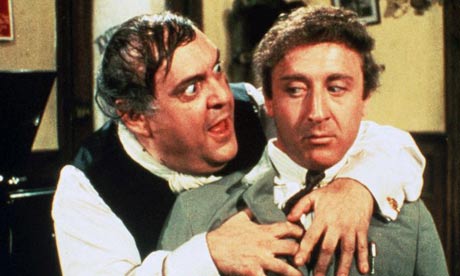
The Producers


The starting point for the analysis of any cultural product (call it text, or whatever you please) is to see it as a productive system. It aims to produce a certain complex of effects upon the person who receives it, views it, interacts with it.

A work that can be said to fail, is a work that does not produce the effects for which it was intended. Artaud. Melville. Bialystock & Bloom.

When we talk about genre films, or genre fiction, we are referring to the effects that the work will visit upon us, the reason that we pick it up, go to the cinema. Action, romance. Each of these words conveys, in a broad sense, the set, or range of personal responses upon which the work will play. Failure then, is also a frustration of our expectation.

When we identify this range, we can then discuss technical and ideological issues. A certain method of montage, cinematographic style, etc., or gender roles, construction of space, etc. these can be assessed, broken up, and reinserted into the understanding as a whole. But technical and ideological are not separate. Not at all. Psycho-cam in Halloween, strong arms in Mills & Boon.

We must ask why our expected responses are played on in specific ways, what modes of behaviour this presumes, and what this (often publically enacted) call-response principle reinforces. Aka, why do boring people like stupid movies & why do artschool wankers like lame-ass pretentious movies?

Tuesday, 25 August 2009

The Agony of the Times

This whole debate on the death of the newspaper is very interesting, and well worth some proper investigation. Clay Shirky is, so far, the best critic of the vain attempts of the newspapers to sustain themselves, and the below quote is quite a nice indication of how badly the business model has been broken, and how increasingly archaic the newspaper form will become.

Meanwhile, back in the real world, the media business is being turned upside down by our new freedoms and our new roles. We’re not just readers anymore, or listeners or viewers. We’re not customers and we’re certainly not consumers. We’re users. We don’t consume content, we use it, and mostly what we use it for is to support our conversations with one another, because we’re media outlets now too. When I am talking about some event that just happened, whether it’s an earthquake or a basketball game, whether the conversation is in email or Facebook or Twitter, I want to link to what I’m talking about, and I want my friends to be able to read it easily, and to share it with their friends.


Shirky's blog has a few very good posts on the topic. Also well worth checking out is Michael Massing's article for the New York Review of Books, and Chris Anderson has some Ok stuff on it as well, but tending towards the superficial.

Wednesday, 19 August 2009

Distributed Leadership in the Obama Campaign

Distributed Leadership in the Obama Campaign

The video above is an excellent, if long, discussion on the development of distributed leadership in the Obama election campaign. The speaker, Marshall Ganz, was a New Lefter, involved in the Student Non-Violent Coordinating Campaign, the United Farm Workers, and had some sort of training role for Camp Obama. The video is worth a look if you have time, but here are the salient points I pulled from it.

What does leadership mean in times of opportunity?
Taking responsibility to enable others to achieve shared purpose in the face of uncertainty.

Stephen Jay Gould mentions two conceptions of time:
- Time as cycle (management, routine)
- Time as arrow (leadership, change)
Both of these are necessary. Time as arrow fits a campaign-organisation suitably, but it also needs to include management and routine. However, the fact of change, and unexpected issues, means that the organisation must be able to adapt, this requires leadership, not management.

Obama campaign had three advantages:
- Message of hope - involved people in shared narrative
- Stategic - set specific goals (local caucases) and built local capacity to win these
- Finance - built an expensive base of small contributors

Moving from Disorganisation to Organisation requires leadership

Disorganisation -> Leadership -> Organisation
Passive -> Motivation -> Participating
Divided -> Relationship -> Community
Chaotic -> Structuring -> Collaboration
Reactive -> Strategy -> Initiative
Inactive -> Action -> Outcomes

Motivation is crucial, because it explores the individual's emotional involvement, their affective mapping of the world. Decisions are ultimately made on the basis of emotional involvement.

Camp Obama identified each of these issues
Motivation: People told their stories of why they were there, what their values were
Relationship-Building: People would have one-on-one meetings, bring discussion back to wider group - develop shared interests
Structuring: Develop interdependent leadership teams
- Decide on norms on which decisions and actions are made
- What are the tasks? who can do what?
Strategising: Give people the tools to identify goals and identify necessary tasks.
Action: Give training in very specific tools

Different Models of Organisation


That's my MSPaint rendition of his diagram, which is not dissimilar to a model I previously drew up. The lateral arrows indicate that links are always being established and drawn between the various groups.

Tuesday, 18 August 2009

What is a 'Distributed' Workforce?

We consider a workforce "distributed" if it meets any of the following three conditions:

- Individual workers are in different physical locations.
- Most normal communications and interactions, even with colleagues in the next office, are asynchronous; that is, they do not occur simultaneously.
- The individual workers are not all employed by the same organisaion, or are working within distinctively different parts of the same parent organisation. They may have widely different terms of employment.

EEach of these three dimensions impacts workforce management in today's economy, and the interactions among them create new skill requirements, demand new management practices, and raise stress levels for everyone. However, these new conditions also present intriguing opportunities for productivity improvement, organisational effectiveness, and enhanced personal satisfaction.

The above is from a short article, Understanding Distributed Work, by The Work Design Collaborative, and available here.

Sunday, 9 August 2009

Eric Fromm The Art of Loving

Just as automatons cannot love each other they cannot love God. The distengration of the love of God has reached the same proportions as the disintegration of the love of man. This fact is in blatant contradiction to the idea that we are witnessing a religious renaissance in this epoch. Nothing could be further from the truth. What we witness (even though there are exceptions) is a regression to an idolatric concept of God, and a transformation of the love of God into a relationship fitting an idolatric character structure. The regression to an idolatric concept of God is easy to see. People are anxious, without principles or faith, they find themselves without an am except the one to move ahead; hence they continue to remain children, to hope for father or mother to come to their help when help is needed.


The Art of Loving, pp93-94